-
Senior Member
Ross Rifle Mk II 5*
Ross Rifle Mk II 5* (Part 1)
A series of articles starting with “The ‘Stepchild’ Ross” by C.C. Meredith appearing in the November 1944 AMERICAN RIFLEMAN magazine and continuing through the ”Reviving the Ross” and “Ross Reversal” by G.H.V Stent in the April 1945 and May 1946 AMERICAN RIFLEMAN piqued my interest in the Ross Rifle. (These articles created quite a controversy in the “Dope Bag” section of the magazine for several months thereafter – both pro and con.) I had never seen one until I walked into a gun shop in New York and saw one leaning over in a corner. I recognized it by its distinct bolt handle shape and asked to examine it and was allowed to do so. I asked the price and the owner said $10. I offered him $5 and we compromised on $7.50. Neither of us could figure out where the serial number was located so the bill of sale simply says “One M1905 Ross Rifle”. From this page I now know how to identify the S/N.
The rifle was only in fair condition. The stock was well used and bore several scars. The bore was/is dark but the rifling is sharp. I have fired the rifle and though it is not marked it does indeed have the large chamber. The cartridge case when extracted has very little neck left, the chamber is so large. The bolt face shows no indication of having been fired much. It is missing the hand guard between the receiver and the rear sight base.
Ross Rifle Mk II 5* Part 2
The description is as follows:
http://i116.photobucket.com/albums/o...le/RossMks.jpg
http://i116.photobucket.com/albums/o...le/Ross675.jpg
LEFT SIDE OF RIFLE:
1. On the left receiver wall is the annotation “Ross Rifle Co, Quebec Canada
1905”. It looks to me as if the stamping was made after the receiver was hardened for it is very shallow.
2. On the barrel there appears to be a pair of crossed flag. In the top opening of the pair is what appears to be a crown. In the bottom opening there appears to be a “P”. In the side openings are marks which I cannot decipher.
3. Just below this there appears a crown and the letters “I” and “Q” running parallel with the bore with the crown on top.
4. On the left side of the stock just behind the rear sight are the numbers “182” and “267”. The 182 is above the 267.
5. On the left but stock just about where the rifleman would lay hs face the numbers are repeated only this time the 267 is above the 182.
6. The stock has two cross bolts: one just even with the rear of the rear sight and the other just even with the front of the trigger guard.
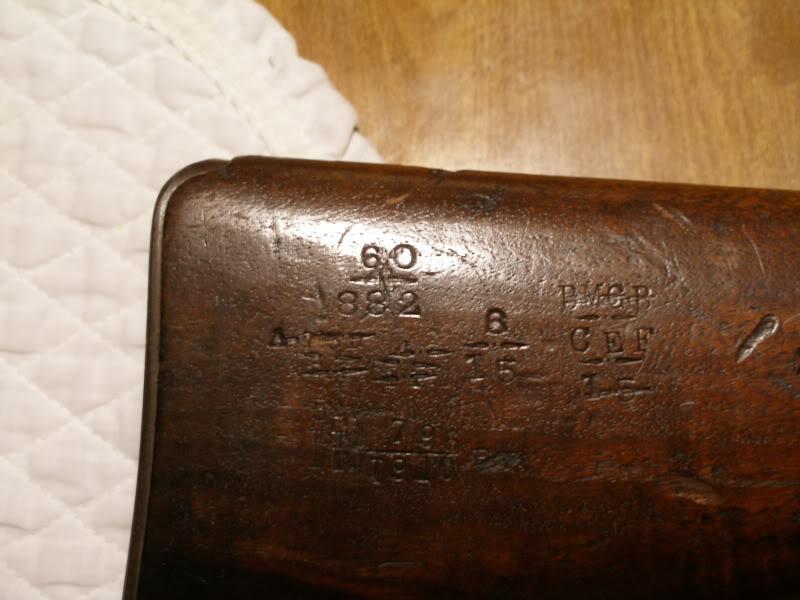
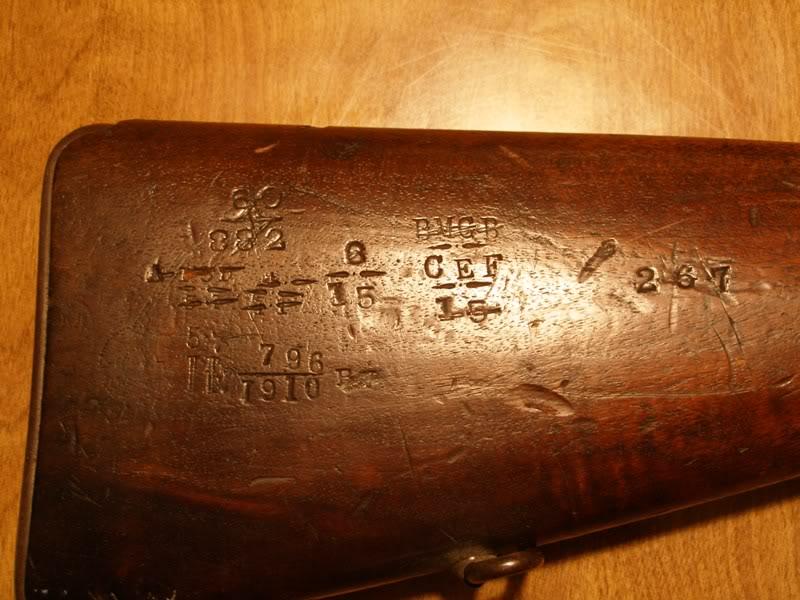
RIGHT SIDE OF RIFLE: Reading from the butt towards the muzzle there appears to be a series of marking which lie essentially in three columns.
1. 60/80
2. Below that A 13D (It looks as if someone had tried to strike over these with a common screw driver to obliterate them
3. Two circles the larger being ¾ inch and the inner one being 3/16 inch. There is some sort of notation in the small circle but I cannot read it. Between the inner circle and the outer circle along the bottom of the larger circle appears the work “Quebec”.
4. To the right of the circle towards the muzzle is the Notation “Roman Numeral II with a 5* above it. Further to the right is the notation “ (Underlined) 796 over 1910”. I take it that this is the S/N and the year of manufacture.
5. Further to the right and in line with the first notation is the notation’ “6/15”
6. Further to the right is the notation in capital letters “BMCD”. This had been “struck out” with the screw driver blade and directly beneath is the notation “CEF”. Below that is the notation: I 5” also struck out with the blade.
Ross Rifle Mk II 5* (Part 3)
The Sights:
1. The rear leaf sight is marked at the top “Sutherland Rifle Sight Co, New Glascow N.S. and is really a wondrous thing. The rear of the leaf is marked: “ Pantd May 22 01, Apr 18 05 and May 21 07. The face is marked 6 to 19. I do not know the units.
2. The slide contains an elevating screw, a lock screw and a windage adjustment screw. The windage part of the slide can be move right or left with an adjustment screw 25 units each calibrated in increments of 5. I do not know what the units are.
3. Along the left side of the leaf are marks of 6/20/80/80 then a big “1”, followed by 20/40/60/80 and a big “2”. The slide is calibrated from 1 to 10 to act as a venire.
4. The bolt is marked “51” on the bottom of the bolt handle rood and along the back is the “crossed flags followed by a crown and a “9”
Ross Rifle Mk II 5* (Part 4)
It is my conjecture that this is a Mk II 5* which made it to France
with the CEF and was used for training. How it made it back to the US is a mystery. There are no markings ast would indicated that it served with the US Army. Some of my information come from “Sir Charles Ross and his Rifle” published by Museum Restoration Service, Ottawa Canada 1969. I would appreciate any comments.
Last edited by Cosine26; 07-25-2010 at 11:50 PM.
-
-
01-02-2010 04:11 PM
# ADS
Friends and Sponsors
-
-
-
-
Member
-
-
Senior Member
Ross Rifle Mk II 5*
I did not purposely omit the letters of the serial number; I just did not know that they were a part. Unfortunately the stock has dent there and I cannot read it in entirety. It is either “BV”, “PV” or “RV”. The dent occurs right where the loop of the “B” or the tail of the “R” would be. I have studied the area with a magnifying glass but the damage is too great to make a positive identification. The rifle does not have provisions for clip or charger slots; however it does still have the “cutoff” and the lifter for aid in loading.
I tried to take pictures but could not get any to come out that that showed the detail s. I shall try again later and post them if I can get them to come out.
Thanks for the input.
-
-
Member
The first letter could only be a "B"- The rifle is too late for an "A", and "P" or "R" are too late for even a 1918-assembled Mk III- my highest Mk III serial ever recorded is 433/1918 OX, and the rifle is clearly one of the "Make-up Run" assembled from left-overs long after the Ross Plant was effectively stolen by the Canadian
Gov't from Sir Charles in early 1917. If you can either post a jpeg of the markings on the right side of the stock or E it to me directly, we can likely identify most or all of the previous owners.....
-
-
Senior Member
Poss MkII 5* Pictures
I have taken some pictures but must figure out how to get defused lighting. Everything looks good until I snap the picture then everything is 'washed out'. Will keep trying
Thanks for the info

Last edited by Badger; 03-09-2011 at 07:58 AM.
-
-
Member

Originally Posted by
Cosine26
Ross Rifle Mk II 5* (Part 1)
A series of articles starting with “The ‘Stepchild’ Ross” by C.C. Meredith appearing in the November 1944 AMERICAN RIFLEMAN magazine and continuing through the ”Reviving the Ross” and “Ross Reversal” by G.H.V Stent in the April 1945 and May 1946 AMERICAN RIFLEMAN piqued my interest in the Ross Rifle. (These articles created quite a controversy in the “Dope Bag” section of the magazine for several months thereafter – both pro and con.) I had never seen one until I walked into a gun shop in New York and saw one leaning over in a corner. I recognized it by its distinct bolt handle shape and asked to examine it and was allowed to do so. I asked the price and the owner said $10. I offered him $5 and we compromised on $7.50. Neither of us could figure out where the serial number was located so the bill of sale simply says “One M1905 Ross Rifle”. From this page I now know how to identify the S/N.
The rifle was only in fair condition. The stock was well used and bore several scars. The bore was/is dark but the rifling is sharp. I have fired the rifle and though it is not marked it does indeed have the large chamber. The cartridge case when extracted has very little neck left, the chamber is so large. The bolt face shows no indication of having been fired much. It is missing the hand guard between the receiver and the rear sight base.
Ross Rifle Mk II 5* Part 2
The description is as follows:
LEFT SIDE OF RIFLE:
1. On the left receiver wall is the annotation “Ross Rifle Co, Quebec Canada 1905”. It looks to me as if the stamping was made after the receiver was hardened for it is very shallow.
2. On the barrel there appears to be a pair of crossed flag. In the top opening of the pair is what appears to be a crown. In the bottom opening there appears to be a “P”. In the side openings are marks which I cannot decipher.
3. Just below this there appears a crown and the letters “I” and “Q” running parallel with the bore with the crown on top.
4. On the left side of the stock just behind the rear sight are the numbers “182” and “267”. The 182 is above the 267.
5. On the left but stock just about where the rifleman would lay hs face the numbers are repeated only this time the 267 is above the 182.
6. The stock has two cross bolts: one just even with the rear of the rear sight and the other just even with the front of the trigger guard.
RIGHT SIDE OF RIFLE: Reading from the butt towards the muzzle there appears to be a series of marking which lie essentially in three columns.
1. 60/80
2. Below that A 13D (It looks as if someone had tried to strike over these with a common screw driver to obliterate them
3. Two circles the larger being ¾ inch and the inner one being 3/16 inch. There is some sort of notation in the small circle but I cannot read it. Between the inner circle and the outer circle along the bottom of the larger circle appears the work “Quebec”.
4. To the right of the circle towards the muzzle is the Notation “Roman Numeral II with a 5* above it. Further to the right is the notation “ (Underlined) 796 over 1910”. I take it that this is the S/N and the year of manufacture.
5. Further to the right and in line with the first notation is the notation’ “6/15”
6. Further to the right is the notation in capital letters “BMCD”. This had been “struck out” with the screw driver blade and directly beneath is the notation “CEF”. Below that is the notation: I 5” also struck out with the blade.
Ross Rifle Mk II 5* (Part 3)
The Sights:
1. The rear leaf sight is marked at the top “Sutherland Rifle Sight Co, New Glascow N.S. and is really a wondrous thing. The rear of the leaf is marked: “ Pantd May 22 01, Apr 18 05 and May 21 07. The face is marked 6 to 19. I do not know the units.
2. The slide contains an elevating screw, a lock screw and a windage adjustment screw. The windage part of the slide can be move right or left with an adjustment screw 25 units each calibrated in increments of 5. I do not know what the units are.
3. Along the left side of the leaf are marks of 6/20/80/80 then a big “1”, followed by 20/40/60/80 and a big “2”. The slide is calibrated from 1 to 10 to act as a venire.
4. The bolt is marked “51” on the bottom of the bolt handle rood and along the back is the “crossed flags followed by a crown and a “9”
Ross Rifle Mk II 5* (Part 4)
It is my conjecture that this is a Mk II 5* which made it to France with the CEF and was used for training. How it made it back to the US is a mystery. There are no markings ast would indicated that it served with the US Army. Some of my information come from “Sir Charles Ross and his Rifle” published by Museum Restoration Service, Ottawa Canada 1969. I would appreciate any comments.

The 796/1910 is indeed the serial no., except there should be a letter or series of letters out to the side, which is also part of the serial no. They only numbered to 999 and then started over with another three digit series with a different letter designation. And, yes, it was mfg. in 1910 with the last of improvements as designated by the 5*.
What kind of ammo did you shoot in it? It fires .303 British
, and if it did that to the case, I suggest you refrain from shooting it. It apparently is not safe. You might part it out, and make more than your $7.50 investment.
-
-
Member
As only one of the custodians of Sir Charles reputation, I must ask you politely : on what do you form your opinion that "it apparently is not safe"? Please don't troop out the old hairy chestnut about the bolt blowing back- that has long since been defined as an urban myth, and the few documented occasions that it did occur only with a 1910-series Ross, not a 1905, it was clearly the result of someone with little or no specific Ross knowledge and/or absolutely no mechanical knowledge or sympathy dismantling the bolt, then incorrectly reassembling it before firing...stupidity has it's own rewards, or as I look at it, it's further proof that God indeed does occasionally vacuum the terminally stupid from the bottom of the gene pool. With sensibly loaded ammunition, no problems except a possible lack of accuracy due to bore wear should occur.
-
-
Really Senior Member
What kind of ammo did you shoot in it? It fires .303
British
, and if it did that to the case, I suggest you refrain from shooting it. It apparently is not safe. You might part it out, and make more than your $7.50 investment.
That is a complete fallacy. The 1905 is very strong and completely safe to shoot.
Rossguy said it correctly. Only an incorrectly assembled bolt on a Mk III/1910 action was dangerous, assembled correctly they are extremely strong.
The chambers were reamed out to make the rifles more reliable with out of spec British ammo, the fact that the case expands when fired is not dangerous or unsafe.
-
-
Member
Assuming the correct end of the rifle is pointed down range
-